Showing posts with label literature. Show all posts

Tuesday, July 09, 2013

Les Liaisons Dangereuses, signed Malkovich

 Wow.

Tonight was opening night of Les Liaisons Dangereuses, directed by John Malkovich, part of the Lincoln Center Festival.
Actors warming up on stage before the play begins
Wow.

I was all wound up in anticipation of this production, for many reasons.  I had studied the epistolary novel by Pierre Choderlos de Laclos as a French major in college, and later actually acted in a community theater production of Christopher Hampton's play wherein I played (ulp) the Marquise de Merteuil (aka Glenn Close).

None of my past experiences -- reading for literature, watching the film, acting in the play -- prepared me for this tour de force.  This is Liaisons Dangereuses as it was meant to be experienced.

Wow.

It was totally brilliant, which is a relief when expectations and ticket prices run high.

In the Director's Notes in the Playbill, John Malkovich says:  "Les Liaisons Dangereuses is a story for the ages.  It is here restored to its original language, and I think today's theatergoers will readily grasp it, even if they don't speak French. It is clear and clean and mean and fast.  It hurts as life invariably does.  It is snotty and decadent and sexy.  It is infantile, tragic, and amusing."

It is indeed all of the above.  The play is highly charged and erotic, and had many in the audience squirming in their seats.  (Some oldsters left at intermission.)  It is witty and superbly staged.  The acting is superlative (with the exception of a vaguely disappointing Mme de Rosemonde, who was just okay).

Highly recommended!


Friday, March 08, 2013

Paris Reborn: the making of Haussmann's Paris

Those who know and love Paris, and think they know all about haussmannien architecture in Paris, will be delighted and informed at an unimagined higher level when they read the absolutely splendid new book by Stephane Kirkland, Paris Reborn:  Napoleon III, Baron Haussmann, and the Quest to Build a Modern City.

I am only three-quarters of the way through the book, which to me is a gripping narrative, a page-turner. If you love Paris as she exists today, you will simply devour each page.  Stephane Kirkland takes his readers through beginnings of Paris modernization and through the city's massive transformation during the Second Empire.

A few highlights:

"Napoleon... had a large new slaughterhouse built on the edge of the city, with one important consequence:  As of September 15, 1828, it became prohibited to drive cattle through the center of town."

Ponder that for a few moments.

Or Queen Victoria's comments on her visit to Paris in 1855:  "What could I say about this most wonderful city in the world?" in an era when Paris was first learning what it meant to be a tourist destination.

Or Baron Haussmann's disagreements with Hittorff.

There are far too many excellent chapters in the life of  19th-century built Paris to enumerate here, so I simply recommend the book. Over and over.

Kirkland captures the drama, both social and political, and opulence of Paris in the mid-nineteenth century, and begs the reader to ask what Paris would have become if Baron Haussmann had not persisted in his determination to carry out the expansive and visionary urban-planning ideals of Napoleon III.  

For those who love Paris today-- all the many millions of you -- this book is a must-read.  You will always walk down the streets and grand boulevards of Paris henceforth with a knowing and appreciative understanding of how they got to be where they are today.

For those who yearn to know and discover Paris, this is a superb architectural primer on the creation of the most beautiful city in the world. (Yes, of course I'm biased.)

Official publication date is April 2, but you might not want to wait that long to order it.  Ask me!

Friday, November 30, 2012

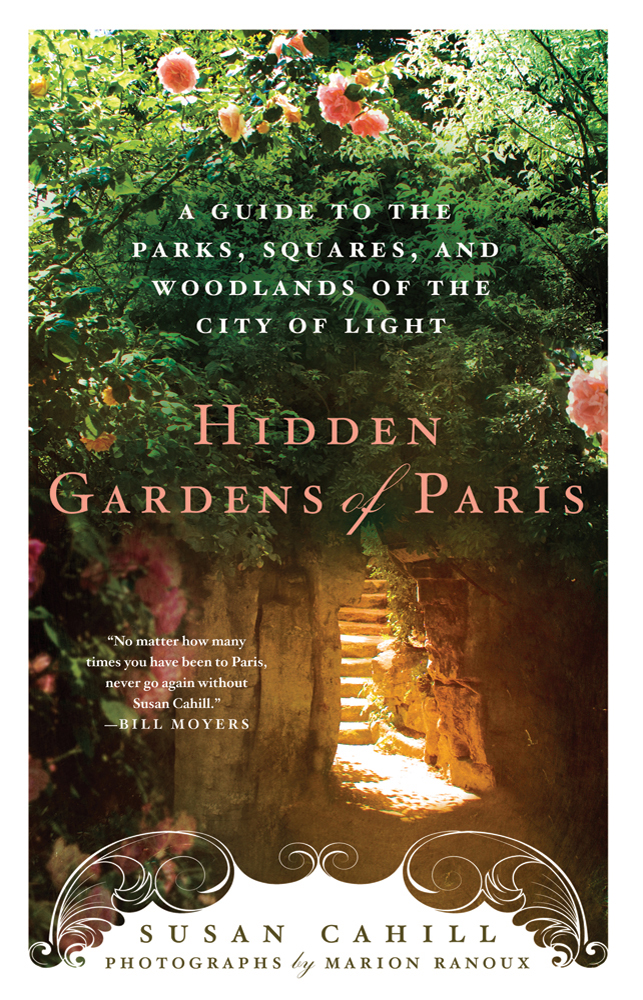
Hidden Gardens of Paris

One of the most amazing secrets about Paris was imparted to me in the first week after I moved there.  At a dinner party, a well-known French author/photographer of luscious French coffee-table books told me, "All courtyards in Paris are legal to enter if the courtyard door opens. It's the law."  I was still bashful about the notion, but somewhat emboldened to give it a try.

Because, of course, some of the most fabulous intimate outdoor sights in Paris are hidden from view from the casual passerby, and require some knowledge and audacity in order to see them.

Mostly we spend our days in Paris walking down the cold stone sidewalks and simply wondering about the greenery on the other side of the wall.

I spent three happy years in Paris on my daily walks trying my best to discover all those hidden spots that serendipity tossed in my path.

But who needs serendipity when you have a copy of Hidden Gardens of Paris?  The hidden gardens included in this great guide range from not-so-hidden (Luxembourg Gardens) to tucked-away treasures, and I can only say that I am never going to meander around Paris again, EVER, without this gem of a book in my arsenal.

Author Susan Cahill artfully organizes the gardens geographically around Paris, and includes places and restaurants to visit nearby.  "Aha!"  you might say, "She didn't include one of my favorites!"  And, yes, it's true, because Paris has so many wonderful hidden green spaces, how could any 220-page tome include them all?  (Picpus Cemetery is one of my favorites, for example.)  But you will not be disappointed - there are ample new places to discover.  This book will simply give you more reasons to keep discovering Paris.

Hidden Gardens of Paris includes so many cultural and local references, it really is a must-have for any trip to Paris if, like me, your vision of Paris includes exploring on foot, outdoors.


Monday, November 26, 2012

An Award for Books about France!

If you've read this blog with much frequency (and of course you have!) you'll know of my unending love of books written about France -- or the discovery of some aspect of France -- by Americans.

Over the last two centuries, many great (and some not so great) works have been written for the anglophone world to explain or showcase France in a way that helps them appreciate or understand France a wee bit or a lot more than they did before.  I have kept a personal library of them, made a habit of collecting and reading them.  To see the vast numbers of books that I have written about in my casual way, check here, or simply click on the category "literature" in the column to the right.

This year I was dreaming and scheming about the fact that this literary genre -- whether fiction, non-fiction, or coffee-table book -- should be awarded a prize in the great tradition of literary prizes.  I came up with a well-laid-out plan. Alas, I did nothing with it but mention it briefly to a CEO of a New York-based French non-profit.  Busy with the day job.  I figured, I'll get around to it.  But great minds, apparently, think alike.

So imagine my delight last month when, at a NYC gathering for my beloved American Library in Paris, I heard the announcement from Director Charles Trueheart that ALP is now sponsoring the American Library in Paris Book Award.  The award will be given each year to  "...the best book of the year in English about France or the French-American encounter."

It is, quite simply, thrilling to have the genre recognized and awarded and by such an august organization and writers' council.

A vos plumes, everyone.  A vos plumes!

Saturday, November 03, 2012

The French W: did you say "dooblah-vay?"


The other day my laptop keyboard was getting cranky, and inexplicably stopped producing the letter "W" unless I bore down with my ring finger's brute force.  This situation, while annoying (I prefer to ignore that left-hand finger) and a bit embarrassing at first (sending "no" when you mean "now," or "itty" when you mean "witty," can get you in some hot ater!), it also got me thinking about missing letters, and especially the letter "W."

It naturally conjured up the decades-old incident about the departing Clinton White House staff removing the letter "W" from keyboards in anticipation of Dubya and the gang moving in.  That anecdote got blown out of proportion, then of course had a full-fledged government commission report.  The initial response in the link above is my preferred kind of playful poisson-d'avril kind of fun.

But ultimately, all of my thought-roads lead to French. Bien sur!  So as I pondered my own missing "W," I mused, "Well, it wouldn't really matter if I were writing in French, because there are precious few French words that begin with the letter 'W'."

Right?

And of course in French the letter is double vé....double-V, not double-U.

And yes, in fact, so there are so few W-words in French that they can all be listed on one page.  Here they are. Check 'em out: there are some standards and some doozies!

Week-end, wharf, wagon, web 2.0., whisky. Some are the usual suspects, but none are very French-sounding, eh?  Except for wisigoth, and methinks even that is an alternate spelling.

And words that simply contain the letter "W" are few and far between.  Hmm: sandwich.  Can you think of others?

One thing I can vouch for: when playing French Scrabble, you definitely don't want to draw the "W" tile,  except that it's worth a gajillion points.

In order to confirm the status of the letter W in French, I plan to wander the streets of Nouveau York and ask random French people (apparently about 50% of the current NYC population, estimated from language overheard on street corners) their opinions of the lettre double vé and I'll report back.  I don't expect a huge response.  But you never know.

Meanwhile....


Thinking of absent letters,  I recently stopped by the library at the fabulous FIAF,  and to my thrifty delight, I found, in their used-book-for-a-buck sale cart, an uncracked edition of La Disparition by Georges Perec.

If you are not familiar with this work (or any of the oeuvre of Perec), it is a 305-page French novel written without using the letter "E."

I'm in havn.

Friday, October 19, 2012

French Chic Book Giveaway

Weee-o!  (Or in French, ouais!) 

This is my first ever book giveaway!  In the past I have been supplied with books to read and review upon occasion; but this time the generous folks at Simon & Schuster have sent me an extra book to offer to readers of Polly-Vous Francais? in a Book Giveaway!

Drum-roll, please.

And this is not just any book.  It is Lessons from Madame Chic:  20 Stylish Secrets I Learned While Living in Paris by Jennifer L. Scott.

Okay, well, damn, I thought when I first heard about this book.  Or "Sniff!" as I wrote to the lovely  Simon & Schuster publicist who offered me the advance review copy, "This was the book I was going to write," I whined.  "Oh well, she who hesitates... blah blah."  So I swallowed my pride (and that half-written manuscript) and eagerly agreed to read the book and offer a book giveaway on ye blog.

Mardon me, Padame, but how the h** does one do a book giveaway?

Keep reading.

Of course one googles the phrase "Book Giveaway" and then picks from the best of the ideas and marches onward.

And so I present:  the Polly-Vous Francais first-ever book giveaway!

Are you still awake?  Would you like a free book?

If you'd like to learn how to be chic like the French women in this book, and get a free book which gives you all the details, simply leave a non-spam, non-anonymous comment below.  And while you're at it you can "like" our Facebook page!   I will print out all the names and cut their email addresses in little strips of paper and then place all the names in a beret before November 6 (the release date of the next edition) and then I will ask a random friend to extract the names from the beret.  Then the winner, selected at random, will be contacted.  Said winner will have to have enough confidence that I am not an axe-murderer to give me her (or his?) mailing address, and then I will send that winner a pristine copy of the wonderful Lessons from Madame Chic.  And I'll actually pay the postage.   And I actually promise to put it in the mail, unlike most of the other letters on my desk which have been languishing in the "to be mailed" pile for lo these many months.

But don't stop reading yet. You need the preliminary review!   Lessons from Madame Chic arrived in this afternoon's mail.  And I can't put it down.  It is a fabulous look at French savoir vivre.  Jennifer Scott never attempts to generalize or make stereotypes, but simply offers one view of chic French life as she observed from a year living in Paris with Madame and Monsieur Chic in the 16e arrondissement.  She balances it with great observations about Madame Bohemienne in the 11e.  No broad-brush "the French are this or that" statements, but simple and astute observations from her year in Paris.

I like that.

I think perhaps some cultural/social evolution has happened since the author first spent her junior year in France (most chic French women now wear jeans?), but this book is nevertheless a great resource, with helpful tips on how to incorporate French chic and practicality into your everyday life.  In every realm from fashion to food to family living to feeding your brain, with chapters such as "Exercise is Part of Living, Not a Chore." You'll be glad you read it. And I think you'll keep it on hand as a reference book.

So, my friends, submit comments below (and "like" us on Facebook for a plus) to qualify to win a free copy of Lessons from Madame Chic!  Comments (or new Facebook "likes") must happen before November 5.

The winner will be informed by November 6.

Sunday, October 14, 2012

Announcing David McCullough's Next Book: Americans in Paris, 20th Century

Breaking news!  This weekend, historian and author David McCullough announced  -- for the first time to the public -- the subject of of his next book:  Americans in Paris from the early 1900's to 1930.  The theme, though, will be fascinatingly different from all other tomes on those all-too-famous Yanks in the City of Light.  His will be a study how the nascent technology of aviation influenced their lives and vice versa.

Speaking at the annual meeting of the Federation of Alliances Francaises in Providence, where he was receiving the coveted Prix Charbonnier for his most recent work on Americans in Paris, The Greater Journey, Mr. McCullough unveiled his latest project.  Realizing, in Paris during a 4-day taping for 60 Minutes, that writing about Paris was in his heart, he knew his next book also had to be about  Americans in Paris in the 20th century.  "But," he said, "I was faced with the problem of 'How can I make it different from so much that has been written?  I cannot go down the same old path about Hemingway, Fitzgerald, and Gertrude Stein, etc. etc.'   I knew it could be done and I knew that there were so many more people than those clichés that they had become, alas.  But what would make it work?  And inform?  What was the perspective or lens through which I could look at this period that would be different?  And then, one day, came one of those moments where suddenly it hit me.  And, honestly, it just lifted me out of my chair.  And that is: aviation.  The advent of flight.  The advent of the airplane.  The most emblematic development of the 20th century."

Here is a brief glimpse of him reading the first page of his new book, describing Edith Wharton in Paris as she witnessed the first airplane to ever fly over Paris,on Monday, October 18,1909.

The video is truncated, alas.  I had to focus on the talk.  Page one had me completely spellbound.  Afterwards, Mr. McCullough said to me, "Well, Polly, if your face was an indication, I guess it will be a hit."


Thursday, August 09, 2012

Every Frenchman Has One

Fifty years ago, Olivia de Havilland, a classic in her own right, wrote a classic about being an American in France. I don't have sales statistics on her memoir Every Frenchman Has One, but I hope it was a best-seller.  She wrote it about the challenges of adjusting to life in France, married to the dashing author Pierre Galante. It still resonates today.

Miss de Havilland is still living in Paris and is as gorgeous and gracious as ever at age 94.  A few years back, at the American Cathedral, I had the delight of talking with her about her book after a service. After some introductory conversation and enthusiasm,  I begged her to re-issue her fabulous and funny book.  It would be an instant "re-born" classic! "Oh, yes, I should do that," she replied in her lilting and charming voice. "I think they still have the plates somewhere."


Oh, and what does every Frenchman have, according to Miss de Havilland?

Ha.  Not so fast, and get your minds out of the gutter.

Every Frenchman has a liver.

Tuesday, June 26, 2012

Fiction


Written in 2007.  Thinking of Nora Ephron tonight.

If she had suddenly left Paris for an emergency and traveled anywhere, she would be in Charleston. But this is fiction. If she were in Charleston, she would think that Charleston is a lot like Paris. Paris on vacation. Paris on Zoloft. Chic women, beautiful historic houses, hidden gardens, tinkling fountains.

But this is fiction. This is just a dream. Not even a nightmare: sometimes pretty and sometimes ugly, as fiction can be.

If she were in Charleston, she would go to the clean, bright bookstore and she would search for the self-help section. Not for herself, for she is Perfect (this is fiction, remember?). If she were searching for a book in the self-help section it would be for this reason. She used to be related to a sad supposedly human being who hoarded many things but mostly what he specialized in hoarding was the entire panoply of DSM-IV disorders. So she would find the book that might start to explain this tortured creature to the unfortunate souls who were to remain related to him for the rest of their lives, or his. It is a book called "I Hate You, Don't Leave Me" and she would be glad that even in a perfect city like Charleston there were at least two imperfect people because there were that many copies of this book in the very tiny self-help section. If she were in Charleston, that is. This is fiction, of course.

And if she were still in that pretty bookstore she would chuckle as she noticed that the Humor section was right across from the Self-Help section, far, far away from the massive Religion section and the even huger Food section. (There was no Fiction section, of course, because this is all fiction anyway.) So she would chortle and think out loud, as they do in Charleston, "Humor IS self-help. In my book." And smile at her bad pun. And she would look to see if the Ephron sisters had published anything new lately and she would find to her delight one slim yellow book called "I Feel Bad About My Neck" by Nora Ephron, and she would scoop it up and head to the cashier.

And if she were walking to the purchase desk she would notice towering shelves displaying dozens and dozens of this very same canary-yellow Nora Ephron book. She would feel pathetically smug knowing that she chose the book before seeing that it was being promoted as a best-seller "Women's Book".

And if she were really in Charleston and really reading Nora Ephron's new book back in her room at the pink stuccoed hotel next door, she would laugh and realize that she too experienced almost everything that Nora Ephron writes about, including real-estate love and book rapture. Excepting, of course, the love of cooking. And that second husband. And then she would think that if she could be so bold, that she would give up her latest personal motto which was "When I Grow Up I Want to Be Mary Blume" and change it to "When I Grow Up I Want to Be Nora Ephron" but since she would have already passed her 52nd birthday she would have to start growing up pretty damn fast.

But, as I said, this is fiction.

Friday, May 04, 2012

Markets of Paris

There are SOO many guide books to Paris.  We've seen 'em all.  N'est-ce pas?

So when I picked up Markets of Paris, in my jaded I-already-know-Paris frame of mind, I didn't have great expectations.

Boy, was I wrong!  Capital-W wrong.

This is a gem of a guide to Paris.

First of all, it is organized in the way that any guide to Paris should be, which is by arrondissement.  Second, it is more than just a guide to the open air food markets in Paris, but rather includes all shopping centers that you could want to visit, from la Grande Epicerie to the Marché aux Timbres and exquisite covered marketplaces such as Galerie Vivienne, and all my other favorite passages couverts.


Oh, did I mention that it is a gem?

It's a gem!

For example, rather than try to have the book serve as a map, the authors recommend the best map book, Paris Pratique, to use in conjunction with the book.  So true!  I never have been able to properly navigate  Paris without a couple of handy guides:  one is never enough.  And, at about 6 by 6 inches, Markets of Paris is petite enough to carry in your bag, but chock-full of information to keep you busy reading while you wait for the RATP bus to take you to your next destination.  It's a big book in a little book's hide.  This and Paris Pratique are all you need.

The book has so much practical information, including even a list of "Helpful Books, Blogs, and Websites" to visit to enrich your Paris market experience -- all of which I heartily endorse.


From small organic food markets to popular flea markets, bargains to luxe, the markets  and material covered in this book make it a definite keeper.

I can't wait to return to Paris this summer and use it as my guide.

Sunday, April 15, 2012

Les zizis de Paris

The moment I happened upon the book Les Zizis de Paris, several years ago, I was smitten.  Not because of the subject per se (though what's not to love?!), but because I delighted in imagining a similar book in an Anglo-Saxon museum bookshop.  Maybe there is one and I just don't know about it, but I'm not holding my breath.  As a culture, I think, we Americans in general are just more disposed to be prudish/woo-hoo about such matters, as opposed to dealing with the subject matter with an appreciative nod and a wink.

Zizi is the French equivalent of wee-wee,  or weenie or what-have-you.  I find it quite adorable as a name for male parts.

I found this charming and entertaining photography book in a museum store of one of the museums of the city of Paris.  Not hidden hush-hush in a brown wrapper in a corner, but prominently displayed with other guides to Paris.  And indeed, it is a pictorial guide to male nude public statues.  What?  Oh yes, of course I bought it!

So, big deal.  It's Art.  No fig leaves.  It's France.  It's the human body.  Deal with it.  Enjoy it.

But I did get a chuckle out of the juxtaposition of the accompanying standard web language on the website for the book...


Thursday, April 05, 2012

Bringing Up Bebe: A Conversation with Pamela Druckerman

Like many Americans who move to France, I have always been surprised to observe the differences in behavior between French and American kids. Seeing a 9-year-old confidently take the RATP bus alone to her music lesson. A 4 year old patiently guarding her baby brother in the stroller at the front of the store while their mom dashed for once forgotten item at the back of the Monoprix. Kids sitting at dinner tables, engaging in conversation.

So you can imagine my delight when I saw that Bringing Up Bébé had just been published. I had met author Pamela Druckerman at the American Library in Paris a few years ago. And we've kept up a bit since then. I was delighted when she was able find time for me to interview her. I just had to know more about the creation of this latest tour de force in deciphering the differences between French and American cultures.


Polly-Vous Francais:
You write about so many wonderful epiphanies in Bringing Up Bébé. Was there one "aha!" moment in particular that stands out? A personal favorite?

Pamela Druckerman: I think it was the moment when a French girlfriend of mine saw my daughter, who couldn’t even stand up on her own at the time, pulling books off our bookshelves (for some reason she always pulled down the travel books - go figure). I hadn’t thought there was anything I could do about this irritating habit of my daughter’s. She couldn’t even talk! But my friend got down on the carpet with my daughter and said, very gently: We don’t do that. We leave the books on the shelves. Then she showed my daughter how to push them back in. To my surprise, my daughter never pulled the books down again. After that, I realized that I could teach my daughter things like that, and she could integrate them. It was a revelation.

PVF: How did you settle on the title? Were there other contenders for the title?

PD: I wanted to call the book Paris is Burping. My editor said what editors say when they are trying to be polite: "Let’s make it a chapter title."

PVF: Nice! I like that one. [Thinking how to translate that title...] And will the book be translated into French? Would you consider returning as a guest on (my favorite French TV show) Le Grand Journal to discuss the differences between French and American parenting?

PD: Yes, the French edition is scheduled for January 2013. Title TBD. Do you handle bookings for Le Grand Journal? :)

PVF: No, but I sat in the audience once. I hope they invite you back for a debate about French/American parenting styles. That would be an entertaining conversation! For example, which of the French parenting methods do you think you've had the hardest time accepting or adopting?

PD: I can't get used to the 5-day field trips for first graders. But I'm going to have to. My daughter starts primaire next year. And though I say “It’s me who decides,” I don’t always automatically believe it. I have to sort of rev up my inner CEO. I’m naturally picky, but I’m not naturally bossy.

PVF: Which was the easiest?

PD: It was cutting out snacks, except for the one in the afternoon. It made the rest of the day flow better. Now when my kids sit down to eat, they're actually hungry.

PVF: Do you think there is a difference between French and American attachment objects (infamous doudous in France, in U.S., blankies or what-have-you)?

PD: I'm not sure. French parents do tend to have long Freudian explanations for why their kids have attachment objects. Whereas American parents would just say the blanket or the stuffed animal is comforting.

PVF: Okay, what about French children and correct posture? Any observations? How about faire la bise?

PD: I didn't look at posture at all (though I’m sitting up straighter as I write this). Please do tell, and I'll get that into the paperback! As for "faire la bise," I probably should have mentioned that too. What are your views?

PVF: Well, I once observed a French friend feeding her 18-month-old in his highchair. She simply cooed "Tiens-toi comme il faut, mon trésor" ("sit up straight, sweetheart") before she would give him the next bite, and it worked like a charm. La bise, of course, will take a whole chapter to discuss: up to what age a child must give a cheek kiss to a visitor, etc. So much to think about! All things considered, if you could start out your own childhood again, would you rather be raised à la française?

PD: I would change nothing at all about my own childhood. And I'm not just saying that because my mother is probably reading this.

Seriously, I think like many American women I wish I had developed a healthier relationship to food early on, instead of a guilt-based one. I wish I had learned how to savor one cookie, instead of needing to eat all eight of them.

PVF: Are there any French movies that might have some examples that illustrate the difference between French and American childhoods? (The Elegance of the Hedgehog comes to mind, but perhaps others)?

PD: On a recent flight to America I watched a wonderful French film called Un Heureux événement about a French couple that meets and has a baby, and how this affects their relationship. At one point during the mother’s pregnancy, she asks the doctor whether it’s okay to swallow semen. The doctor replies: Yes, it’s very nutritious. But of course it shouldn’t be the baby’s only food!

PVF: Hahhaha! Excellent. Okay, er, switching gears here, tell me, where do you write in Paris? Favorite spots? Favorite parks to go avec enfants?

PD: I write at home or at an office that I share with seven French journalists. I'm their token foreigner. I also write in cafes sometimes, though it’s hard to find one with the right combination of laptop friendliness, good coffee, good writing vibe, and a power outlet.

With kids, I love the Tuilleries, which has in-ground trampolines and a very imaginative, sculptural playground. One of the great things about Paris is that there are playgrounds all over the place. There’s usually at least one within walking distance. And there are wonderful film festivals just for kids.

PVF: Do you think that WWAFMD* will become a household mantra?

PD: Well since I had to read that acronym five times before I figured out what it stood for, probably not! I do think a new conventional wisdom about parenting is gradually emerging in America, and that it overlaps in some ways with the French style (date nights, having kids eat more interesting foods, teaching patience…). But whatever the next phase is in America, it's not going to be a carbon copy of French or Chinese or Eskimo parenting. It will be its own house blend.

PVF: Pamela, thanks so much for taking the time to chat. This might seem totally random as a closing question, but I personally think it's related: Do you think French dogs are exceptionally well behaved, too?

PD: How did you know? That's my next book! Though if French dogs were really were so well behaved, they wouldn't leave their poop on the sidewalk.


*What Would A French Mother Do?

Sunday, June 05, 2011

Midnight in Paris

I settled into my cinema seat and waited impatiently through the coming attractions for the feature film to begin. Ready for my Paris fix by watching the much-discussed Midnight in Paris. The film began, with the brassy, jazzy trumpet music playing over the familiar sights of my favorite city.

But… something was wrong.

The colors.

Everything seemed too yellow. “Woody Allen got it all wrong, “ I was thinking. I am way too possessive about my Paris knowledge. “Is he trying to make it look like Kodachrome or something?” I was fuming just a little. “The light in Paris is silvery, not gold. The buildings are soft grey, and he is trying to make the buildings look as if they are all made of sandstone.” Even the gold leaf on the fountain at the place de la Concorde was too shiny, and the verdigris was too green. The wet nighttime streets should be reflections of pewter and chrome, not glimmers of gold. It wasn’t MY Paris, in any case, I harrumphed inwardly. What was he thinking??

Nevertheless, thrilled with seeing familiar spots, I somehow managed to refrain from elbowing Miss Bee at recognition of every panorama, every street scene in the introduction. I just reveled in knowing virtually every locale. Miss Smuggy-pants. When Owen Wilson first walked into Le Bristol, I couldn’t resist and leaned over and whispered “That’s Le Bristol.”

It’s occasionally truly obnoxious to be in the role of “I used to live in Paris.” This was no exception. I tried hard to suppress my oh-so-superior knowledge of the settings. Especially since Woody had gone so overboard on the gold. His shots of the admittedly posh Le Bristol seemed over-the-top in the gilt and gold-plate department. I didn’t get it.

But soon enough I was ensconced in the plot, and the cinematographic details took a back seat.

I did, however, almost jump out of my seat and hissed loudly to Bee, “That’s DEYROLLE!” In the scene with the champagne-soaked party surrounded by taxidermied animals. “Drole?” she whispered back. “D-E-Y-R-O-L-L-E! Deyrolle, my favorite taxidermy store!” I was beside myself.

I hate people who talk in movies.

As the movie progressed all I could do was admire Woody Allen's brilliance. This film was a magical modern-day fantastic tale interwoven with "The Kugelmass Episode," Back to the Future, and Grimm's "The Twelve Dancing Princesses."

Then, at one point, Owen Wilson's and Marion Cotillard's characters were in deep conversation about what it means to live in a golden era. One's nostalgia for a more golden era is sometimes missing the point that the golden era is actually the present.

"Ah," I sank back in my seat.

The golden-yellow light of Paris was brilliant, Mr. Allen.

Saturday, April 30, 2011

Murder in Paris: How About You?

Have you always longed for a sliver of immortality? Do you especially dream of that immortality intersecting with Paris? Well, here is your chance.

Acclaimed author Cara Black, of the Murder in Paris series, has generously offered to name a minor character in her next novel -- for a good cause! The French American International School in San Francisco will offer to the winning bidder at the school's annual fund-raising auction on May 7 the chance to be a minor character in Cara's next Paris-based novel. The kind of immortality that normally one just can't buy. Interested parties who can't attend the event can bid by proxy.

The juicy details: the character might be murdered or maimed, or might be the snitch or the all-seeing neighborhood boulanger or concierge. The only disclaimer is that the name needs to be French or willing to get Gallicized. "John" would become "Jean," for example. "Polly" would be.. hmm. Pauline? Poulette? I'm working on it.

The fame, fun, and glory?

Priceless.

Tuesday, March 29, 2011

Suite francaise

I awake in the pre-dawn hours, befuddled and anxious.

Will our family have enough to eat? I wonder.

Will we reach Tours? Will it be safe when we get there?


Then, slowly I awake. I rub my eyes and realize it is 2011. I am safe in my comfortable American bed. Breakfast awaits.


As I gaze sleepily around the room, I remember that I am reading, and totally absorbed by, Suite française, by Irène Némirovsky.


Published in 2006, it's one of those books I'd been "meaning to read" and couldn't decide whether to read it in French or English. If it's one of those books that you have been "meaning to read," please do so. I'm reading the English edition, exquisitely translated by Sandra Smith.


Universal Studios apparently bought the movie rights in 2006. I don't usually clamor for a great novel's film version, but this is one that I can't wait to see.


It is also one of those books that I want to know the ending of but that I don't ever want to end.


Have you read it?

Saturday, March 19, 2011

Dictee de la Baie


Does anyone else besides me remember the names of every French teacher they ever had? I recall each one: Madame Rhodes, Mademoiselle de Mauduit, Madame Lambert -- too many to list -- all the way through college.

And believe me, their names and voices and red-pen marks came rushing back to memory today as I climbed into the seat to compete in this year's Dictée de la Baie, more or less the French/francophone version of a spelling bee. There were 150 contestants from the Bay Area, ranging in age from 6 to over 60.

In the category Adult Francophiles, there were about 20-25 of us gathered in the schoolroom, fidgeting, joking nervously, jovially eyeing the competition. Lining up our papers and pencils.

Muriel, the dictant, began:

"Les vieilles femmes qui avaient eu la lourde responsabilité d’habiller la jeune fille pour son repos éternel avaient scrupuleusement respecté les coutumes mortuaires. Une icône de la vierge était placé sur sa poitrine, bien calée entre ses bras en croix. Au-dessus de sa tête, un petit miroir devait chasser les démons tentés de s’approcher du cadavre..."

...and on to the the end of a long passage. Then, sentence by sentence, she repeated the passage*, and we scribbled ferociously. One more time all the way through. But I could hardly bear to look at what I'd written: I knew I'd start second-guessing myself and thus had to rely mostly on first impulse. A quick review for egregious errors and I flipped it over. Done. Palms a little sweaty and the pencil worn down.

Then we swapped our dictées with our neighbors, corrected the dictée per the passage projected on the large screen at the front of the class. I thought I had done pretty well, but couldn't remember if I'd flubbed a few accents. Muriel gathered the corrected the dictées and announced the results.

First place, with 1 mistake: Polly.

I was both thrilled and supremely embarrassed. Can't explain it: I didn't anticipate that reaction because I didn't anticipate winning.

At the awards ceremony, I got a book, a certificate, and congratulatory cheek bisous from Corinne Pereira, the French Deputy Consul General.


But the biggest prize was rising to a personal challenge.


So, mes amis, on days when I think my foggy boomer-brain has turned to mush, I can at least pat myself on the back reassuringly and say, "Ah, but Polly, you sure do great accents aigus."


* passage by Romanian author Liliana Lazar, I found out afterwards.

Friday, July 16, 2010

24 Hours in Paris

So many times when my circadian cycle was off-kilter with the "regular" hourly schedule of my fellow Parisians, I longed for an hour-by-hour guide that might tell me where I could be amused or consume lovely French fare while the rest of Paris slept or ate breakfast or was busy with their charming cinq-a-septs.  To no avail.  "Ah, there's a book waiting to be written," I thought.

Well, wait no more:  24 hours in Paris is here!

I could wax poetic about Marsha Moore's quirky and lovable new round-the-clock guide to La ville lumiere.  But instead, I'll simply offer you 24 reasons why I love 24 Hours in Paris:

24. A turkish bath where you can order dinner
23. La Chapelle Expiatoire
22. Unmentionable!
21. She loves Deyrolle as much as I do.
20. Metro line 14
19. Chapelle de la Medaille Miraculeuse
18. O Chateau -- we love Olivier!
17. The Dog Cemetery
16. Merci
15. Fabulous factoids. "It would take 24 days, using every hour in the day, to briefly view all the exhibits in the Louvre."
14. Drouot
13. Drouot again.
11. A bar that is open from 9h to 7h.  That is not a typo.
10. Midnight movies followed by breakfast.
9. Going to see "Auntie."
8. Berthillon (I drool!)
7. "24 hours with the kids."
5. Polly Maggoo.  Because there's more than one Polly in Paris.
4. Eternal favorite Shakespeare & Company
2. Stripper School.  Non, pas wallpaper: oui, va-va-va-voom!

And -- drumroll please:  numero un is

1.  Cafe de la Mairie (a fave):  Marsha spells it correctly.  Not Cafe de la "Marie," people!

Great book, a must-have for anyone who loves and frequents Paris.


Sunday, January 31, 2010

Americans in Paris during the Occupation

For someone like me who is fascinated with

1) day-to-day life of Parisians during the Occupation,

and

2) Americans in Paris ever since there have been Americans,

Americans in Paris: Life and Death Under Nazi Occupation 1940-44   by Charles Glass

is one I simply have to read right away.

Monday, October 12, 2009

Inside the Embassies of Paris


Paris, as a capital city, is host to hundreds of embassies, many in sumptuous palaces. But the grand architecture we now associate with the missions of the foreign countries wasn't always the case.

During the Ancien Regime, most foreign emissaries to Paris were housed wherever appropriate lodging could be found -- and often according to the value of their good graces to the Court and a complex hierarchy of precedence.

But in the 19th century, with increased international relations, came the necessity of finding permanent dwellings for these foreign ministries. The opportunity for housing befitting a nation presented itself in the wake of the French Revolution. Many grand mansions of the aristocracy, now vacant, were acquired for the diplomatic missions.

Each of these beautiful hôtels in the "noble faubourgs" of Saint Germain and Saint-Honoré, and the rococo palaces near the Parc Monceau, is now a small island of homeland of the country it represents. As such, they are not normally open to the general public (although a few might fling open their doors briefly on les Journees du Patrimoine.)

We thus too seldom have a chance to view their lush, gilt interiors, their art treasures and ornate carved panelling. These chancelleries and embassies remain as mysterious to us as the intricate codes of diplomacy.

Now we have the good fortune -- at least in book form -- to peek inside for the first time.  In Ambassades à Paris, author and historian Elisabeth Martin de Clausonne and photographer Hermine Cleret take us inside for a tour of these magnificent buildings. Text is in French, but the photos speak for themselves.


Wednesday, September 16, 2009

What French Women Know, Part 2

What do you get when you cross a francophile and a bibliophile? 

This:
A lot of great books have been written by women attempting to explain the French mystique.  These are just the ones that I own, that I could find quickly. They are piled up in no particular order.  All but one written by non-French women.  All worth a read.  (Yes, that is Olivia deHavilland's book you see in the middle.  Written in the 1950s and still timely!)

It's not an exhaustive collection; and feel free to suggest your favorites if not included in the photo.  Off the top of my head, most notably missing are books I've lent to friends, such as Petite Anglaise, Paris Hangover, and everything by Diane Johnson.

Making any list is terrible because there will be unforgivable omissions.  I humbly apologize in advance (like fraulein Maria kissing the ground before the nuns walk by). 

Please go out to your local bookstore or library or favorite online book source, and enjoy these.

As I said, I'm a francophile and a bibliophile.  I wanted to pay tribute to an incredible posse of writers describing what French women know. 
Locations of visitors to this page
Travel Blogs - Blog Catalog Blog Directory blog search directory Targeted Website Traffic - Webmasters helping webmasters develop high value relevant links. Promoting ethical web-marketing using the time trusted pillars of relevance and popularity.